Bus Servo Wiring and Power Solutions
This guide helps you choose an appropriate wiring and power setup based on the number of servos used in one system.
- Standard Applications (1-6 servos)
- Complex Applications (7-14 servos)
- Large-Scale Applications (15 servos and above)
Standard Applications (1-6 servos)
Use this setup for single systems with 1-6 servos under light-load conditions.
This approach is suitable when:
- The current-carrying capacity of the adapter board is sufficient.
- The voltage drop on the wiring remains within an acceptable range.
- The loss at connectors and terminals remains within the safety margin.
Recommended wiring methods:
- Daisy-Chain
- Parallel Connection
- Combined Daisy-Chain and Parallel Connection
For heavy-load conditions, such as applications using 100 kg·cm high-torque servos, reduce the number of connected servos according to the actual total operating current of the system.
Caution
The total operating current through a single UC-01 adapter board must not exceed 20 A.
Daisy-Chain

Parallel

Complex Applications (7-14 servos)
Use this setup for single systems with 7-14 servos.
As the number of servos increases, pay particular attention to:
- The power demand of each individual servo
- Voltage drop along long wiring runs
- The current-carrying capability of the data cables
Recommended setup:
- Use a distribution board for power branching and distribution.
- Power the distribution board from an independent main power loop to reduce line loss and improve power stability.
- Use the matching distribution board directly, or design a suitable distribution board circuit according to your project requirements.
Design recommendation:
- Keep the number of servos connected in Daisy-Chain within a single branch to no more than 6.
- For high-torque or heavy-load applications, reduce this number accordingly.
Typical recommended hardware:
- PH8 UART Serial Bus Servo Distribution Board
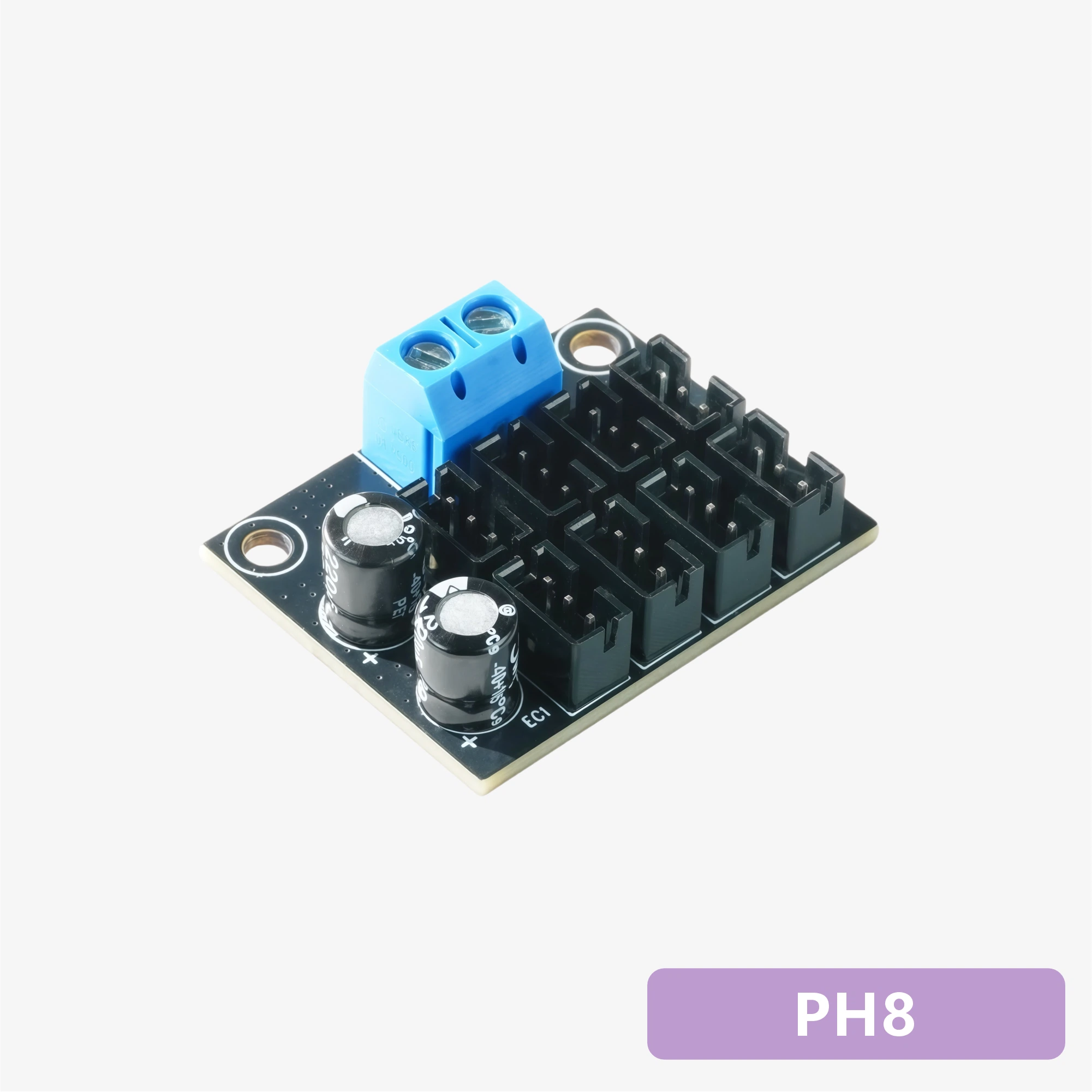
Recommended wiring layouts are shown below for reference.
Recommended Wiring Layout

Large-Scale Applications (15 servos and above)
Use this setup for single systems with 15 or more servos.
At this scale, it is recommended to use multiple distribution boards for grouped power supply and signal distribution, so that no single path becomes overloaded.
Wiring principles:
- Between distribution boards, and between each distribution board and the UC-01 adapter board, only the following lines need to be connected:
- Signal line (S)
- Power negative (-, GND)
- Once the adapter board is connected to the main controller, all servos on the bus can be controlled together.
- Refer to the diagrams and video below for typical wiring examples.
Wiring Diagrams


Data Cable Modification Instructions
The supplied data cable can be modified as shown below for:
- Connections between distribution boards
- Connections between a distribution board and the UC-01 adapter board
| Before Modification | After Modification |
|---|---|

|

|
Wiring Video Demonstration
This video helps you quickly understand the wiring process and the key points.
Tip
- If the embedded video fails to load, please watch it on Bilibili.
Notes and Warnings
Warning
1. Maximum daisy-chain cable length
The maximum communication cable length between two adjacent servo units must not exceed 1 m. If the cable length exceeds 1 m, a shielded cable is required to reduce signal interference and attenuation.
2. Voltage drop under high current
Due to the inherent impedance of connectors and power cables, voltage drop and power loss can occur under high-current conditions. In actual designs, verify the setup against the real application scenario, and use the measured voltage under full operating conditions as the final acceptance criterion.